Čeští hráči mají dnes na výběr z desítek online kasin, a proto se vyplatí sledovat nejen výši bonusu, ale i podmínky pro jeho získání. Mezi nejvyhledávanější nabídky patří 10 eur zdarma za registraci, které potěší především začátečníky. Popularitu si drží také 100 free spiny bez vkladu, ideální pro rychlé vyzkoušení automatů bez rizika. Kdo preferuje platbu kartou, může využít 100 kč paysafecard zdarma a zahrát si okamžitě po vložení.
Mnohá kasina lákají nové hráče na 100 kč za registraci automaty, což je skvělý způsob, jak poznat nabídku bez větší investice. Alternativou pro příznivce eura je 20 eur za registraci bez vkladu, případně mezinárodně zaměřený 20 no deposit casino bonus. Nejnižší vstupní bonus nabízí 5 eur zdarma za registraci, vhodný pro testování herních mechanismů.
Před registrací se vždy vyplatí přečíst si hodnocení ostatních hráčů. Podrobný 69 casino recenze odhaluje silné i slabé stránky provozovatele. Zkušenosti s českou značkou shrnuje admiral casino recenze, zatímco milovníky moderních automatů potěší apollo games casino recenze. Díky těmto informacím zvolíte kasino, které odpovídá vašim preferencím i rozpočtu.
Český trh s online kasiny je dnes mimořádně rozmanitý a hráči si mohou vybírat mezi desítkami provozovatelů. Pokud hledáte co nejvýhodnější start, začněte u nabídky, která nevyžaduje žádný vklad – tedy casino bonus za registraci bez vkladu. Právě takové akce vám umožní vyzkoušet provozovatele nanečisto a teprve poté se rozhodnout, zda do hry vložíte vlastní peníze. Vedle toho se vyplatí sledovat i pravidelné casino bonusy, jako jsou free spiny, reload bonusy nebo věrnostní programy pro stálé hráče.
Nabídka herních titulů je opravdu široká – od klasických automatů přes stolní hry až po živé krupiéry. Portály, které se specializují na casino hry, obvykle nabízejí přehledné filtrování podle poskytovatele i volatility, takže si snadno najdete titul odpovídající vaší strategii. Stále více hráčů navíc zkouší bitcoin casino, kde vklady i výběry probíhají v řádu minut a zcela bez zásahu banky.
Před registrací se ale vždy vyplatí zjistit, jak si daný provozovatel stojí u ostatních hráčů. Detailní betor casino recenze vám prozradí, jak rychle se zpracovávají výběry a jak kvalitní je zákaznická podpora. Stejně užitečná je i bonver casino recenze, která shrnuje zkušenosti s bonusovými podmínkami a limity pro výběr výher.
U platebních metod je dobré si předem ověřit, co konkrétní kasino podporuje. Mnoho hráčů preferuje možnost casino minimální vklad 100 kč paysafecard, protože jde o rychlý a anonymní způsob platby bez zadávání údajů o kartě. Jiní zase oceňují casino vklad přes sms cz, který je ideální pro okamžité dobití účtu přímo z mobilu. Pokud hledáte širší výběr provozovatelů a štědřejší podmínky, může být řešením casino online zahraničí, tedy licencované zahraniční kasino, které přijímá i české hráče. A pokud nechcete riskovat ani korunu, pomůže vám automaty bonus za registraci bez vkladu, díky kterému si zahrajete zdarma a bez jakéhokoli vkladu.
Český trh s online hazardními hrami se za poslední roky výrazně proměnil a hráči dnes mají na výběr z desítek licencovaných i zahraničních platforem. Stále více lidí přitom hledá crypto casino, které nabízí rychlé vklady a výběry bez zapojení banky. Než ale vložíte první korunu, vyplatí se projít si forbes casino recenze a porovnat reputaci, licenci i rychlost výplat jednotlivých provozovatelů.
Velkou roli při výběru hraje samozřejmě bonusová nabídka. Pokud chcete mít přehled o aktuálních akcích, sledujte free spiny dnes, protože se obměňují doslova každý týden. Zvláštní kategorií jsou free spiny za registraci bez vkladu, díky nimž si můžete kasino vyzkoušet, aniž byste museli vložit vlastní peníze.
Mezi tradiční české značky, které stojí za pozornost, patří fortuna casino recenze, kde se dočtete o licenci, platebních metodách i zákaznické podpoře. Novější hráči často zvažují grandwin casino recenze a stále častěji se objevuje také kartáč casino recenze, která hodnotí mimo jiné rychlost registrace a bonusové podmínky.
Základem každého kasina jsou pochopitelně hrací automaty, ať už jde o klasické tříválcové přístroje, nebo moderní video automaty s bonusovými funkcemi. Pokud si je chcete nejprve osahat bez rizika, můžete vyzkoušet hrací automaty zdarma 81 nebo režim hrací automaty zdarma neomezeně, v němž si strategii vyzkoušíte tak dlouho, jak budete potřebovat.
Hledáte spolehlivé online casino cz? V našem přehledu najdete ty nejlepší herny pro české hráče. Začněte třeba u luckybet casino recenze, která vám ukáže výhody i nevýhody tohoto provozovatele. Podobně důkladně jsme sepsali i maxa casino recenze, abyste věděli, co očekávat.
Mezi nejlepší online casino patří i nové platformy, které přinášejí svěží vítr do světa hazardu. Pokud vyzkoušíte nové casino online, můžete získat atraktivní vítané nabídky. Pro milovníky mobilního hraní doporučujeme mobilní casino, které je optimalizované pro telefony a tablety.
Velkým lákadlem jsou bonusy bez vkladu. Například nové online casino bonus bez vkladu vám umožní hrát zdarma a vyzkoušet hry před vložením peněz. Specifickou nabídkou je online casino bonus bez vkladu 7, který nabízí sedm eur nebo sedm spinů zdarma. Nezapomeňte si přečíst také nv casino recenze, kde hodnotíme podmínky tohoto bonusu.
Pro ty, kdo chtějí točit online automaty za peníze, je důležité vybrat kasino s vysokou výplatností a rychlými výběry. Věříme, že s naším průvodcem najdete ideální místo pro zábavu i výhry.
V českém prostředí se hráči zajímají nejen o samotné hry, ale také o pohodlné platby a výhodné nabídky. Pokud preferujete platby přes internetovou peněženku, vyplatí se prozkoumat možnosti jako paypal casino, kde lze často vložit vklad rychle a bez složitého ověřování. Alternativu pro ty, kdo chtějí platit předplacenou kartou, představuje paysafecard casino, které ocení zejména hráči dbající na soukromí.
Mezi oblíbené moderní hry patří Plinko a k němu se vážou i atraktivní nabídky. Pokud hledáte možnost vyzkoušet hru bez rizika, určitě vás zaujme plinko bonus bez vkladu. Před registrací se také vyplatí zjistit aktuální promo kód casino, který může navýšit vklad nebo přinést další výhody.
Čeští hráči často srovnávají známé značky. Podrobný sazka casino recenze pomůže posoudit nabídku her, platební metody i zákaznickou podporu. Pro rychlé transakce je vhodné zvážit také skrill casino, které bývá dostupné v řadě online casin.
Před výběrem je dobré číst zkušenosti ostatních. star casino recenze i tokyo casino recenze vám mohou napovědět, jaké bonusy a podmínky jednotlivé platformy nabízejí. Velkou pozornost si zaslouží i nabídky pro nové hráče ze zahraničí, například zahraniční casino bonus bez vkladu nebo zahraniční free spiny bez vkladu, které lze často využít bez prvního vkladu.
V České republice si dnes můžete zahrát prakticky odkudkoli – stačí si vybrat spolehlivý portál a ověřit si licenci. Mezi českými hráči jsou dlouhodobě nejoblíbenější české casino, která nabízejí platby v korunách, českou zákaznickou podporu a bonusy bez zbytečných podmínek. Pokud dáváte přednost atmosféře skutečného stolu, vyplatí se před registrací prostudovat živé casino recenze, kde se dozvíte, jak kvalitní je stream, jak rychlé jsou výplaty a jaké limity sázek můžete očekávat. Ať už hrajete automaty, nebo preferujete live krupiéry, vždy sázejte zodpovědně a jen v mezích svých možností.
AMR, RGV & AGV: The Intelligent Floor-Level Fleet That Completes Your Automation
The automated warehouse is a symphony of specialized machines. Stacker cranes command the vertical heights; shuttles penetrate the dense depths; conveyors establish the continuous flow. Yet between these islands of automation—from the ASRS outbound station to the packing line, from goods receipt to the buffer zone, from the production line to the finished goods warehouse—there exists a critical gap. This is the domain of floor-level, flexible transport.
AMR, RGV, and AGV are not competing technologies. They are complementary instruments in a fully orchestrated material flow system, each selected for its unique ability to solve specific transport challenges. KINGSHELVING does not ask you to choose a single technology; we engineer the optimal blend of fixed and flexible transport to create a seamless, end-to-end material flow tailored to your operational DNA.
Within this portfolio, a fundamental distinction governs system design: RGV is deterministic infrastructure; AMR/AGV is adaptive capacity. The Rail-Guided Vehicle is the high-speed, high-precision backbone of your internal logistics—a fixed asset engineered for predictable, relentless duty cycles. Autonomous and Automated Guided Vehicles are the agile, reconfigurable fleet that extends automation beyond the rack, delivering flexibility where paths change, destinations multiply, and human collaboration is essential.
Core Positioning: The floor-level connective layer that bridges islands of automation; not a single technology, but an orchestrated portfolio of complementary transport solutions.
Strategic Distinction: RGV as deterministic infrastructure—fixed-path, high-throughput, non-negotiable system component. AMR/AGV as adaptive capacity—flexible, reconfigurable, value-optional fleet.
KINGSHELVING Philosophy: We do not sell vehicles; we engineer integrated transport ecosystems. The right technology, in the right ratio, for your unique material flow.
I. RGV – Rail Guided Vehicle: The Deterministic High-Speed Backbone
Definition and Core Characteristics
The Rail Guided Vehicle is the sprinter of the automated warehouse. It operates on a dedicated track system—fixed, precision-engineered rails that constrain its path but liberate its performance. Unlike free-roaming vehicles that must continuously sense, decide, and adapt, the RGV commits its full computational and mechanical resources to one objective: moving loads as fast as physics permits, with absolute positional certainty.
This is not a limitation; it is a design optimization. By eliminating the overhead of autonomous navigation, the RGV achieves:
Superior speed: Horizontal velocities of 120–180 m/min, limited only by load stability and track geometry
Deterministic positioning: Repeatable stop accuracy of ±3–5 mm, enabling direct handshake with stacker cranes, shuttles, and automated workstations
Zero navigation uncertainty: No path planning, no obstacle negotiation, no deadlock resolution—every mission executes identically
Ruggedized reliability: Fewer sensors, simpler controls, proven mechanical transmission; designed for 24/7/365 duty cycles measured in decades
RGV in the KINGSHELVING ASRS Ecosystem
Within automated storage and retrieval systems, the RGV serves three critical functions that no other technology can perform with equivalent efficiency:
1. High-Speed Pallet Distribution
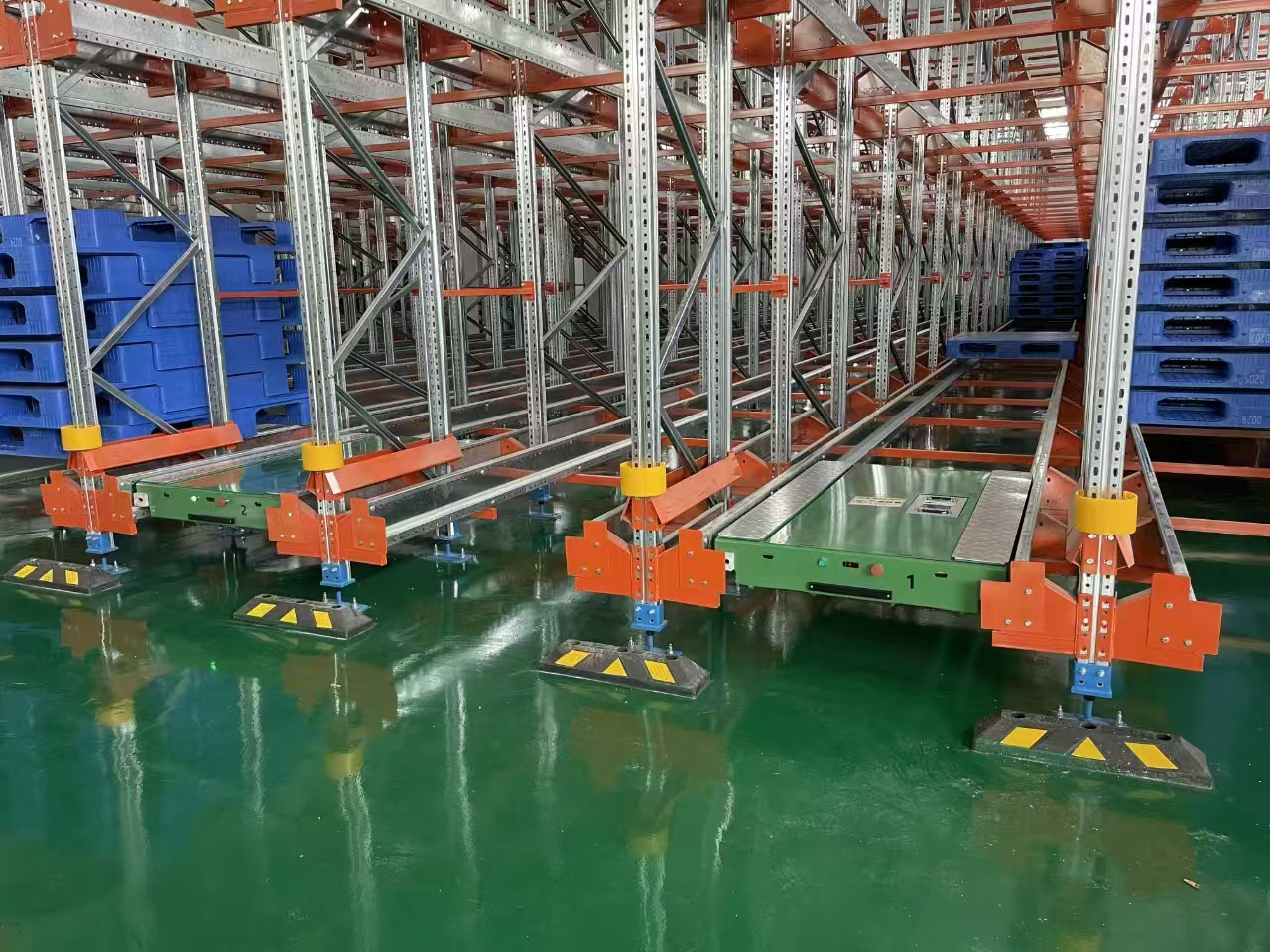
At the interface between ASRS outbound stations and downstream processes, RGV systems achieve transaction rates that free-roaming vehicles cannot match. A single RGV on a dedicated track can service multiple outbound lanes, induction stations, or production line infeed points with sub-second handshake reliability. For facilities processing thousands of pallets per shift, this deterministic performance is not a preference—it is a mathematical necessity.
2. Cross-Aisle Transportation in Multi-Block ASRS
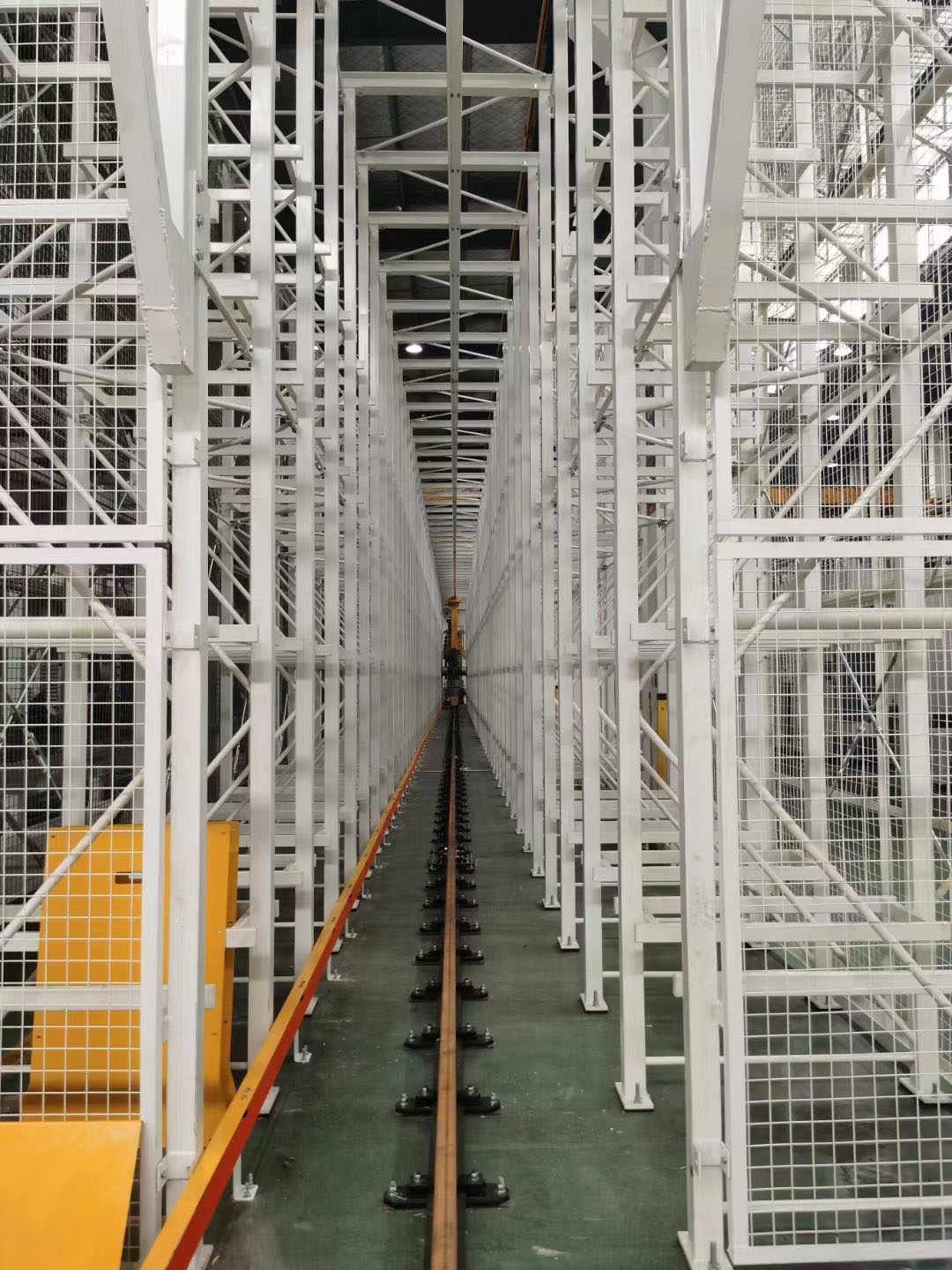
Large-scale automated warehouses often comprise multiple rack blocks separated by service aisles. RGVs operating on transverse tracks connect these blocks into a unified storage system, transferring pallets between cranes and enabling dynamic load balancing across the facility. Unlike conveyor bridges that consume fixed floor space, RGV tracks can be extended, reconfigured, and scaled as storage capacity expands.
3. Linear Production Line Feeding
In automotive, heavy equipment, and high-volume manufacturing, production lines demand precisely timed, sequenced delivery of components. RGVs operating parallel to assembly lines deliver pallets and totes to designated workstations with takt-synchronous precision. The fixed track eliminates the variability inherent in free-roaming systems, ensuring that line-side inventory buffers remain minimal and production stoppages due to material delay are eliminated.
When RGV Is the Right Choice
Your transport task is linear or cyclical along a fixed, high-utilization route
You require deterministic throughput with guaranteed cycle times
The facility layout is stable over the system’s design life
Load weights exceed 1,000 kg and require ruggedized, industrial-grade transport
Integration with ASRS equipment demands millimeter-level positioning accuracy
KINGSHELVING RGV Engineering Advantages
Modular track systems: Precision-ground rail profiles with integrated power and data busbars; installs on existing floors with minimal civil works
Multi-vehicle coordination: Proprietary anti-collision and scheduling algorithms enable multiple RGVs on shared tracks, maximizing throughput without deadlock risk
Hybrid power architectures: Opportunity charging via conductive busbars or inductive pickups; continuous 24/7 operation without battery swap interruptions
Environmental hardening: -30°C cold-rated configurations for freezer logistics; IP54-sealed electronics for dust and humidity; ATEX-compliant options for hazardous areas
II. AGV – Automated Guided Vehicle: The Predictable, Proven Workhorse
Definition and Core Characteristics
The Automated Guided Vehicle is the established veteran of floor-level automation. For decades, AGVs have reliably transported materials along fixed paths defined by physical or optical infrastructure—magnetic tape, reflective tape, inductive wires, or laser targets. This is not legacy technology; it is mature, de-risked, and exceptionally cost-effective for applications where routes are stable and operational patterns predictable.
AGV navigation is deterministic by design. The vehicle does not interpret its environment; it follows a precisely defined digital pathway. This yields several distinctive advantages:
Lower acquisition cost: Simpler sensor suites and control architectures reduce upfront investment
Predictable behavior: Routes are 100% repeatable; no path-planning variability
Proven reliability: Millions of operating hours across manufacturing, warehousing, and logistics globally
Simplified fleet management: Centralized traffic control eliminates vehicle-to-vehicle negotiation complexity
AGV in the KINGSHELVING Automation Portfolio
KINGSHELVING deploys AGV technology where its inherent characteristics deliver optimal system-level value:
1. High-Volume, Fixed-Route Replenishment
In facilities where material flow patterns are established and stable—raw material delivery from receiving to ASRS infeed, finished goods transport from outbound to stretch wrappers, waste removal to compactors—AGVs execute these missions with unvarying consistency. The infrastructure investment (tape, markers, reflectors) amortizes over millions of cycles, yielding lowest total cost of ownership.
2. Heavy-Load Transport
AGVs remain the preferred solution for loads exceeding >2,000 kg. Their simpler mechanical architecture accommodates heavier chassis, larger drive motors, and industrial-grade suspension systems. For coil handling, engine transport, and heavy pallet movements, AGVs deliver unmatched payload capacity.
3. Integration with Legacy Systems
Facilities with existing AGV fleets, established infrastructure, or conservative engineering standards benefit from AGV technology’s backward compatibility and vendor-agnostic interoperability. KINGSHELVING’s AGV control systems communicate via standard fieldbus protocols, enabling seamless integration with PLC-based material flow controllers.
When AGV Is the Right Choice
Your transport routes are stable and not subject to frequent reconfiguration
Load weights exceed AMR practical limits (>1,500 kg continuous duty)
You prioritize lowest initial investment over maximum route flexibility
Existing facility infrastructure already accommodates magnetic/optical guidance
Regulatory or safety standards mandate deterministic, non-adaptive vehicle behavior
The Economic Case for AGV: Converting Labor Volatility to Capital Certainty
The most compelling argument for AGV adoption resides not in engineering specifications but in financial statements. Manual material handling—forklifts operated by human drivers—is a systemic source of operational unpredictability. Labor availability fluctuates; wages inflate; turnover disrupts continuity; injuries impose unplanned costs and reputational damage .
AGV implementation fundamentally restructures this cost profile. A single AGV operating 24/7 performs the work of 2–3 full-time employees per shift, with no overtime premiums, no workers’ compensation claims, and no recruitment expenses. The cost structure shifts from volatile, labor-driven operational expenditure to predictable, asset-driven capital expenditure. Industry studies document typical ROI realization within 18–24 months, with the business case strengthening each additional shift the system operates .
III. AMR – Autonomous Mobile Robot: The Flexible, Adaptive Enabler
Definition and Core Characteristics
The Autonomous Mobile Robot represents the convergence of robotics and artificial intelligence. Unlike AGVs that follow prescribed paths, AMRs navigate using simultaneous localization and mapping (SLAM) —continuously sensing their environment, constructing real-time maps, and dynamically planning optimal routes. They require no floor-embedded markers, no reflective targets, and no infrastructure modifications.
This autonomy unlocks transformative capabilities:
Infrastructure-free deployment: Operational within days, not weeks; no facility downtime for tape application or magnet installation
Dynamic obstacle negotiation: AMRs detect pedestrians, forklifts, and transient obstacles—and navigate around them without stopping
Real-time rerouting: When primary paths are congested, AMRs calculate alternative routes instantaneously
Fleet scalability: Additional robots join the operational fleet via software configuration; no track extensions, no control system reprogramming
AMR in the KINGSHELVING Automation Portfolio
KINGSHELVING deploys AMR technology as the flexible extension layer of our integrated material flow solutions:
1. Dynamic Goods-to-Person Fulfillment
In e-commerce, pharmaceutical, and high-SKU distribution environments, order profiles shift continuously. AMRs transport totes and cartons from dense storage buffers to picking workstations, adapting in real time to order batching changes, workstation assignments, and priority expedites. The fleet scales elastically with order volume—more robots during peak seasons, fewer during lulls—without facility modification.
2. Collaborative Line-Side Delivery
Modern manufacturing emphasizes human-robot collaboration. AMRs deliver components directly to assembly workstations, navigating autonomously through pedestrian-trafficked aisles. Advanced safety sensors enable close-proximity operation without physical guards, preserving floor space and operator accessibility . When production sequences change, AMR missions update via software; no track relocation, no guide path reprogramming.
3. Multi-Stop, Multi-Destination Logistics
Facilities with numerous pickup and drop points—hospitals, laboratories, multi-tenant warehouses—benefit from AMR’s ability to service hundreds of locations within a single software-managed map. Unlike AGVs that require distinct guide paths to each destination, AMRs compute unique routes on demand, maximizing flexibility while minimizing infrastructure complexity.
When AMR Is the Right Choice
Your facility layout is subject to change—expansions, reconfigurations, new process introductions
Transport tasks involve multiple, frequently changing destinations
You seek rapid deployment with minimal facility disruption
Human-vehicle collaboration and coexistence are operational requirements
You value future-proofing and the ability to scale capacity incrementally
The AMR Value Proposition: Flexibility as a Competitive Weapon
In an era of e-commerce volatility, omni-channel complexity, and supply chain uncertainty, infrastructure is liability. Magnetic tape pathways that must be lifted and reapplied; optical markers that require recalibration; guide wires that necessitate floor cutting—these are not assets; they are constraints.
AMRs liberate material flow from these constraints. When Black Friday volume surges, you deploy additional robots—not temporary labor. When a production line reconfigures for new model introduction, you update software—not facility infrastructure. When a warehouse expands into adjacent space, you extend the digital map—not the guide path network.
This is not merely operational efficiency; it is strategic agility. AMR technology transforms material handling from a fixed cost center into a variable, scalable capability—adapting to business dynamics rather than resisting them .
IV. Technology Comparison: Selecting the Optimal Instrument
| Dimension | RGV | AGV | AMR |
|---|---|---|---|
| Navigation Principle | Fixed rail; mechanical constraint | Fixed path; magnetic/optical/laser guidance | Autonomous; SLAM; dynamic path planning |
| Infrastructure Requirement | Dedicated track system | Floor tape, magnets, reflectors, or wires | None; facility-native operation |
| Path Flexibility | None; rail-bound | Low; requires physical guide path modification | High; software-defined mission updates |
| Obstacle Handling | Stop until clear (unless multi-vehicle coordinated) | Stop until clear | Reroute dynamically around obstacles |
| Typical Speed | 120–180 m/min | 60–90 m/min | 30–60 m/min (application-dependent) |
| Positioning Accuracy | ±3–5 mm | ±10–20 mm | ±20–50 mm |
| Payload Capacity | 1,500–3,000 kg | 500–5,000 kg | 100–1,500 kg |
| Deployment Timeline | Weeks (track installation) | Days–weeks (infrastructure application) | Hours–days (software configuration) |
| Relative Cost (Per Vehicle) | Low–Medium | Medium | High |
| Total Cost of Ownership | Very Low (decades of service) | Low–Medium (infrastructure maintenance) | Medium (shorter lifecycle, lower maintenance) |
| Ideal Application | High-speed linear transfer; ASRS interface | Fixed-route heavy transport; stable workflows | Dynamic, multi-destination; collaborative environments |
V. The KINGSHELVING Integration Advantage: Not Vehicles, But Systems
The critical insight that distinguishes KINGSHELVING’s approach is this: a fleet of individual vehicles is not a solution. Value is not created by the movement of empty robots; it is created by the orchestrated flow of materials—the right load, delivered to the right location, at the right time, in perfect synchronization with upstream supply and downstream consumption.
This orchestration demands capabilities that transcend vehicle-level specifications:
Unified Control Architecture
KINGSHELVING’s material flow control platform manages RGV, AGV, and AMR fleets through a single, unified software instance. Traffic rules, mission priorities, and deadlock resolution protocols are applied consistently across heterogeneous vehicle populations. The operator interface presents a unified view of all floor-level transport assets—regardless of underlying technology, manufacturer, or navigation principle.
Intelligent Handshake Integration
The moment of transfer—between conveyor and RGV, between AGV and ASRS outbound station, between AMR and production line infeed—is the highest-risk transaction in the material flow sequence. KINGSHELVING’s control systems implement closed-loop handshake protocols that verify load presence, confirm transfer completion, and recover from anomalies without human intervention. Position verification sensors, load-centering guides, and interlocking logic ensure that every handshake is deterministic.
Dynamic Fleet Balancing
In facilities combining multiple transport technologies, workload distribution is rarely static. KINGSHELVING’s fleet management algorithms continuously monitor mission queues, vehicle availability, and system-level throughput targets—dynamically assigning missions to the optimal vehicle for each task. RGV for high-speed trunk line transfer; AGV for heavy pallet delivery; AMR for multi-stop expedition. The system optimizes the whole, not merely the sum of its parts.
Scalable, Future-Proof Architecture
The optimal technology mix today may not be optimal tomorrow. KINGSHELVING’s control platform is designed for incremental, non-disruptive evolution. Add AMRs to an existing RGV/AGV installation; replace AGV fleets with AMRs as infrastructure ages; expand track networks as facility footprints grow. The control system accommodates change without re-engineering, preserving your automation investment across technology generations.
VI. Application Validation: Floor-Level Transport in Integrated Systems
Automotive Manufacturing – RGV as Production Spine
At a major Chinese automotive assembly plant, KINGSHELVING deployed a dual-RGV circular track system interfacing with 12 ASRS outbound stations and 24 production line infeed points. The system achieves sustained throughput of 65 pallets per hour with zero collisions over 18,000 operating hours, enabled by our proprietary hybrid variable neighborhood tabu search scheduling algorithm . Each RGV travels 140 kilometers per month—distance equivalent to Shanghai to Hangzhou—while maintaining ±4 mm positioning accuracy.
Heavy Equipment Logistics – AGV for High-Capacity Transport
For a global construction equipment manufacturer, KINGSHELVING integrated 2000 kg payload AGVs into an existing ASRS-to-assembly material flow. The vehicles transport engine assemblies, transmission components, and hydraulic systems along fixed magnetic guide paths, synchronized with production line PLC via Profinet. The system replaced a 12-vehicle forklift fleet, eliminated line-side damage incidents, and achieved full ROI within 14 months—substantially below industry average .
E-Commerce Fulfillment – AMR for Dynamic Goods-to-Person
At a leading omni-channel retailer’s regional distribution center, KINGSHELVING deployed a 55-vehicle AMR fleet operating in collaboration with 30 pallet shuttles and 4,500 tote positions. The AMRs receive dynamic mission assignments from the WMS, transporting totes between dense storage buffers and 16 goods-to-person workstations. When order volume surges 300% during promotional events, additional AMRs are deployed via software activation—no infrastructure modification, no temporary labor .
VII. The KINGSHELVING Commitment: Technology-Neutral, Outcome-Focused
Floor-level transport is not a product category; it is an engineering discipline. The optimal solution for your facility cannot be determined by a specification sheet or a vendor’s product portfolio. It emerges from rigorous analysis of:
Material flow patterns: Volumes, velocities, origins, destinations, and temporal distributions
Facility constraints: Column grids, aisle widths, floor flatness, and expansion plans
Operational volatility: Seasonality, product mix evolution, and business growth trajectories
Integration interfaces: ASRS, conveyors, production equipment, and enterprise software systems
KINGSHELVING brings no inherent bias toward RGV, AGV, or AMR technology. We manufacture and integrate all three—and we recommend the optimal blend based on your unique requirements, not our manufacturing capacity.
This technology-neutral objectivity is the foundation of our clients’ trust. When KINGSHELVING specifies a material flow architecture, the client can be confident that the recommendation reflects engineering rigor, not commercial agenda.
Your Floor. Your Flow. Your Optimal Fleet.
The distinction between RGV, AGV, and AMR is not a matter of technological superiority. It is a matter of application fit. Each technology represents a distinct set of engineering trade-offs—between flexibility and determinism, between infrastructure investment and operational agility, between acquisition cost and total cost of ownership.
KINGSHELVING’s expertise resides not in advocating a single technology, but in orchestrating the optimal blend. We deploy RGV where routes are fixed and throughput is paramount. We deploy AGV where predictable, heavy-duty transport is required. We deploy AMR where adaptability and rapid deployment are strategic imperatives. And we integrate all three into a unified, software-managed material flow ecosystem that performs as predictably as a single machine.
This is not vehicle procurement. This is transport architecture engineering—delivered by a partner who manufactures the hardware, develops the software, and bears lifecycle accountability for system performance.
The automated warehouse moves on rails, on tapes, and on algorithms. It flows on KINGSHELVING intelligence.